A note before you read. Dal makes Ayn, one of the eight alternatives below. Every claim about ComplyAdvantage and the other vendors comes from their own websites and press releases, read on 22 or 25 October 2026. Where a page did not say something, we write "not stated on the pages we read". It may still be true, so ask the vendor.
Key takeaways
- ComplyAdvantage sells screening data and an API, with sanctions changes available within minutes, and a Mesh platform that adds transaction monitoring, payment screening and fraud detection [5][6]. Its Starter plan starts at $99 a month for 100 monitored entities [7].
- GCC firms compare alternatives for local reasons. The pages we read do not state Arabic name matching, the GCC national lists by name, or where a GCC customer's data is hosted [5][7][8]. Saudi and UAE rules make the first two essential [1][3].
- First decide what you are replacing: the screening data and API, or the whole platform with monitoring and case management. The eight alternatives below are grouped that way.
- One alternative states on its pages that client data is hosted in the GCC: Ayn, in Saudi Arabia [9]. Two state Arabic name matching: Ayn and FOCAL by Mozn [9][13].
- Never switch with a gap. Run both tools on the same client base, compare the results, then cut over and keep the old records.
The short answer
The best ComplyAdvantage alternative for a GCC firm is the one that covers its national lists by name, matches Arabic names, keeps data where its regulator expects, and does as much of the AML job as the firm needs in one place. For a Saudi-regulated firm that wants screening, Nafith and Makken, monitoring and STRs in one platform hosted in the Kingdom, Ayn by Dal is built for that [9][10][11]. For a bank that wants Arabic-first matching with monitoring and fraud, FOCAL by Mozn is the other Riyadh option [12][13]. For a firm that only wants to replace the screening data, LSEG World-Check and LexisNexis Bridger Insight XG are the global data sets [16][18]. For a fintech that wants a pay-per-check API, Sumsub and Sanction Scanner are the closest swaps [19][21]. For a large bank, NICE Actimize is an enterprise AML suite [23].
What ComplyAdvantage offers
ComplyAdvantage covers a lot, and it is worth knowing what you would give up.
- Screening data. Sanctions, politically exposed persons (PEPs) and their relatives and close associates, watchlists, adverse media and enforcement data. Sanctions changes are "available within minutes", PEPs are monitored daily, and its adverse media system processes "10M+ pages" a day [5].
- Languages and integration. Lists are crawled "with 14 languages supported", and screening runs by real-time API, batch or SFTP [5].
- The Mesh platform. Customer and company screening, transaction monitoring, payment screening and fraud detection, with alert reviews and investigations inside the platform and a "regulator-ready audit trail" [6].
- Self-service pricing. The Starter plan runs from $99 a month for 100 monitored entities, up to 2,000, with monthly billing and cancellation at any time to the end of the billing cycle. Enterprise, priced on application, adds transaction monitoring, payment screening and unlimited usage [7].
Why GCC firms compare alternatives
Six questions push a GCC compliance team to look at other tools. Ask them of ComplyAdvantage too: the answer may be yes.
- Are our national lists covered, by name? Saudi CMA-licensed firms screen the UN Security Council lists and the Saudi national sanctions lists [1], plus the Nafith and Makken order lists by ID number [2]. UAE firms screen the UAE Local Terrorist List [3]. The ComplyAdvantage pages we read do not name GCC lists [5].
- Does it match Arabic names? The CMA requires matching that catches aliases, spelling variations and transliterations [1]. ComplyAdvantage crawls lists in 14 languages; Arabic name matching is not stated on the pages we read [5].
- Where will our data sit? Hosting regions are not stated on the ComplyAdvantage pages we read [8]. Saudi firms can read the data rules in our guide to choosing a CMA-compliant KYC platform.
- Do we want onboarding in the same place? Mesh covers screening, monitoring and fraud; KYC and KYB onboarding are not named on the Mesh page we read [6]. Some alternatives run onboarding, screening and monitoring together.
- Does it produce what our regulator asks for? In Saudi Arabia, suspicious transaction reports go to the General Directorate of Financial Intelligence (SAFIU) [24], and the CMA requires a written reason to close a false positive [1]. Regulatory report filing is not named on the Mesh page we read [6].
- What will it cost at our volume? ComplyAdvantage charges per monitored entity on Starter and by quote on Enterprise [7]. Model every option on your real client count, with continuous screening on.
The eight alternatives at a glance
- Ayn by Dal: replaces screening and monitoring. Arabic matching, Saudi lists, Nafith and Makken; KYB, transaction monitoring and STRs; data hosted in Saudi Arabia; priced per monitored client a year [9][10][11].
- FOCAL by Mozn: replaces screening and monitoring. Arabic-first matching, 1,300+ lists "enriched with region-specific depth", monitoring and fraud; from Riyadh; price by quote [12][13].
- azakaw: replaces screening and monitoring. KYC, KYB, screening and transaction monitoring in a compliance operating system built for MENA; price by quote [15].
- LSEG World-Check: replaces the screening data. A researched data set with the World-Check One platform; names in different languages and scripts; price by quote [16][17].
- LexisNexis Bridger Insight XG: replaces the screening data and software. WorldCompliance data with 180 sanctions lists; account and payment screening; cloud or on-premise; price by quote [18].
- Sumsub: replaces the screening API. Screening in a suite with ID verification, KYB and transaction monitoring; from $1.35 per verification [19][20].
- Sanction Scanner: replaces the screening API. 3,000+ lists, a 250 ms average response; plans by entities screened a month [21][22].
- NICE Actimize: replaces the platform at enterprise scale. Screening, monitoring, case management and STAR reporting; price by quote [23].
Built for the region
1. Ayn by Dal
Ayn is Dal's compliance platform, built by former CMA regulators for firms regulated by the CMA, SAMA, REGA and the Insurance Authority [9]. Its screening covers 2,700+ international watchlists, global sanctions, PEP databases and adverse media across 600K+ sources, plus Saudi lists including the Ministry of Interior, Ministry of Finance circulars, SAMA's shared lists, Nazaha, Tadawul, the Presidency of State Security and Umm Al-Qura, and it automates Nafith and Makken [9][10].
- Compared with ComplyAdvantage: Ayn names the Saudi lists, states an Arabic matching algorithm with AI-powered match recommendations, and creates no-match reports for CMA entities automatically [9]. It also covers onboarding, KYB through Wathq, transaction monitoring with 13 built-in scenarios, and STRs drafted "in line with SAFIU recommendations" [9][11]. All data is hosted in Saudi Arabia, in a dedicated database for each client firm [9].
- What to check: Ayn is built for Saudi-regulated firms [9]. If you hold clients in other GCC states, ask Dal to confirm their national lists. Pricing is per monitored client a year with a minimum starter plan, not self-service [9].
- Best for: Saudi-regulated firms, above all CMA-licensed capital market firms, that want screening, monitoring and reporting in one platform.
2. FOCAL by Mozn
FOCAL is the AML and fraud platform of Mozn, which is headquartered in Riyadh with an office in Dubai [12]. Its screening covers "more than 1300 sanctions, PEP, RCA, and regulatory lists, enriched with region-specific depth" [13].
- Compared with ComplyAdvantage: what Mozn calls "patented Arabic-first AI designed to match complex Arabic names", re-screening on every watchlist update or KYC change, and KYC, transaction monitoring and fraud on one platform [12][13]. In January 2026, Chartis Research named Mozn a category leader for AML transaction monitoring and for KYC data and solutions [14].
- What to check: the pages we read do not name the GCC lists it carries or say where data is hosted [13].
- Best for: banks and larger financial firms that want Arabic-first matching with monitoring and fraud.
3. azakaw
azakaw calls itself "The Compliance Operating System" and describes itself as built for the MENA region [15]. It combines digital KYC and KYB, onboarding, screening for "sanctions, PEPs and negative news", transaction monitoring with case management, and corporate compliance [15].
- Compared with ComplyAdvantage: onboarding and KYB sit in the same tool as screening and monitoring, with regulator-specific templates [15].
- What to check: list counts, Arabic name matching, hosting and pricing are not stated on the pages we read [15].
- Best for: firms in the region that want one workflow from onboarding to monitoring.
Global data providers
4. LSEG World-Check
World-Check is LSEG's research data set on higher-risk people and organisations, built from "international, national and local sources" under defined inclusion criteria [16]. World-Check One is the screening platform for reviewing matches, managing cases and keeping an audit trail [16].
- Compared with ComplyAdvantage: a researched data set you can use in LSEG's platform, by API, or inside other screening products [16]. LSEG's API fact sheet says it screens names "in different languages and scripts" [17].
- What to check: record counts, the GCC national lists by name, and pricing are not stated on the page we read [16]. World-Check does not replace transaction monitoring.
- Best for: firms that want to swap the screening data and keep, or buy, separate monitoring.
5. LexisNexis Risk Solutions: Bridger Insight XG
Bridger Insight XG is screening software on LexisNexis WorldCompliance data: 8M+ risk profiles, 180 global sanctions lists, 1,700 enforcement lists and 3.4 million+ PEP profiles, with news from sources in 59 languages [18].
- Compared with ComplyAdvantage: one engine screens both accounts and payments, any change to a client or a list is rescreened automatically, and it runs in a public or private cloud or on-premise [18].
- What to check: Arabic name matching and the GCC national lists are not named on the page we read [18].
- Best for: banks that want account and payment screening together, in a private cloud or on-premise.
Screening and verification by API
6. Sumsub
Sumsub screens against global and national sanctions lists, including OFAC, UN, HMT, EU and DFAT, plus PEPs and adverse media, from 50,000+ sources across 240+ countries and territories [19]. Screening sits in a suite with ID verification, KYB, transaction monitoring, fraud prevention and case management [20].
- Compared with ComplyAdvantage: identity verification and KYB from the same vendor, continuous rescreening, and AI triage that Sumsub says handles 95% of matches before a person reviews them [19]. Its page lists a price "starting from $1.35 per verification" [19].
- What to check: Arabic name matching and the Middle East are not mentioned on the pages we read [19][20].
- Best for: digital businesses that want verification and screening from one API.
7. Sanction Scanner
Sanction Scanner covers "more than 3000 different Sanctions, PEP, Wanted and Watched lists from over 220 countries", plus adverse media and ongoing monitoring [21].
- Compared with ComplyAdvantage: a REST API with a stated 250 ms average response, a free single check on its website, and plans priced by entities screened a month [21][22].
- What to check: Arabic name matching and the GCC national lists are not stated on the pages we read [21].
- Best for: smaller firms that want a quick screening API on a monthly plan.
Enterprise AML suite
8. NICE Actimize
NICE Actimize's AML suite covers KYC, sanctions screening, suspicious activity monitoring (SAM), suspicious transaction activity reporting (STAR) and currency transaction reporting (CTR), with investigation and case management [23].
- Compared with ComplyAdvantage: a suite built for large institutions, with suspicious transaction and currency transaction reporting named on its page [23].
- What to check: deployment models, Saudi clients or offices, Arabic and pricing are not stated on the page we read [23].
- Best for: large banks that want an enterprise AML suite.
How to switch without a gap
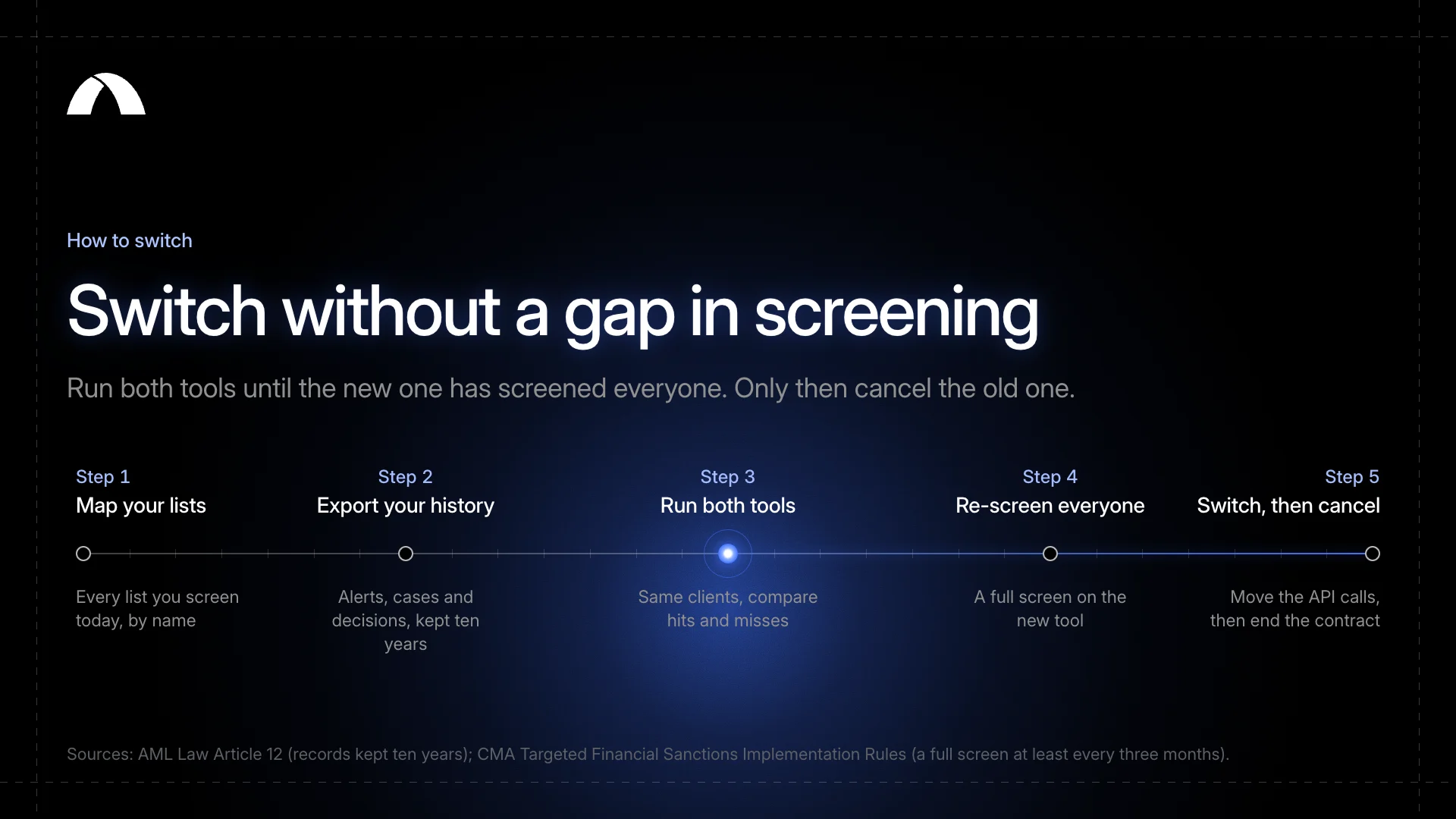
A screening tool cannot go dark for a day. Plan the move in five steps.
- Map your lists. Write down every list you screen today, and confirm the new tool carries each one by name, including the national lists your regulator expects [1][3].
- Export your history. Take every alert, case and decision out of the old tool before access ends. Due diligence records are kept for at least ten years after a relationship ends [24].
- Run both tools. Screen the same client base on both for a set period, and compare what each finds, what each misses, and how many false alerts each raises.
- Re-screen everyone. Before you switch off the old tool, run a full screen of all clients on the new one. CMA firms need a full screen at least every three months anyway [1].
- Switch, then cancel. Move your API calls and team to the new tool, then end the old contract. ComplyAdvantage's monthly plans run to the end of the billing cycle after you cancel [7]. CMA firms should also check whether the change needs 30 days' notice to the CMA as an important outsourcing arrangement [25].
How to choose
- A CMA-licensed firm in Saudi Arabia. Start with tools that name the Saudi lists and Nafith and Makken, and that leave the records the CMA asks for [1][2].
- A firm regulated in the UAE. Confirm the UAE Local Terrorist List and the 24-hour freeze, from list update to frozen account [3][4].
- A firm that only wants new screening data. Compare LSEG World-Check and LexisNexis on your own client file, and keep your current workflow.
- A fintech that pays per check. Compare Sumsub and Sanction Scanner on price at your volume and on API speed.
Then test before you sign. Give each vendor the same file of test names, in Arabic and in Latin letters, including names from a public sanctions list written in several spellings.
To see Ayn screen a client base against Saudi and global lists, including Nafith and Makken, Book a Demo at getdal.sa.
Frequently asked questions
What is ComplyAdvantage?
A provider of AML screening data and software. It screens against sanctions, PEPs, watchlists, adverse media and enforcement data, and its Mesh platform adds transaction monitoring, payment screening and fraud detection [5][6].
What is the best ComplyAdvantage alternative for Saudi Arabia?
For Saudi-regulated firms, Ayn by Dal names the Saudi lists, automates Nafith and Makken, and hosts data in Saudi Arabia [9][10]. FOCAL by Mozn is the other Riyadh-built option, with Arabic-first matching [12][13].
Does ComplyAdvantage support Arabic?
Its screening page says lists are crawled in 14 languages [5]. Arabic name matching is not stated on the pages we read, so test it with Arabic names in Latin letters.
How much does ComplyAdvantage cost?
Its Starter plan starts at $99 a month for 100 monitored entities, up to 2,000. Enterprise, which adds transaction monitoring and payment screening, is priced on application [7].
Which alternatives include transaction monitoring?
On the pages we read: Ayn, FOCAL by Mozn, azakaw, Sumsub and NICE Actimize [9][12][15][20][23]. LSEG World-Check, LexisNexis Bridger and Sanction Scanner focus on screening.
How do I switch screening tools without a gap?
Map your lists, export your alert and case history, run both tools on the same clients, re-screen your whole base on the new tool, and only then cancel the old one.
Which lists must a GCC firm screen against?
The UN Security Council lists and the national lists of each country it operates in. Saudi CMA-licensed firms screen the Saudi national sanctions lists [1] and Nafith and Makken [2]; UAE firms screen the UAE Local Terrorist List [3].
How was this list put together?
Dal makes Ayn, which is on the list. We read ComplyAdvantage's and each alternative's own pages and press releases on 22 and 25 October 2026, used only what they state, and marked what they do not state. We did not test the tools ourselves, so ask each vendor to confirm the points that matter to you.