Key takeaways
- The Ministry of Commerce's Beneficial Owner Rules took effect on 4 January 2026. Minister of Commerce Decision No. (99) of 26 November 2025 issued them, and they replaced the first rules from 2025 [1][2][3].
- They apply to every company under the Companies Law, except joint stock companies listed on the market [1].
- A beneficial owner is always a natural person. Three tests apply in order: 25% or more of the capital, directly or indirectly; effective control by other means; and, as a last resort, the director, a board member or the chairman [1].
- A company keeps a register, files any change within 15 days and confirms its data every year [1].
- A CMA-licensed firm still verifies the beneficial owners of every company client itself [5][7].
The short answer
Every company under the Companies Law must know its beneficial owners, record them and report them to the Ministry of Commerce [1]. A beneficial owner is a person, never a company. The first test is ownership: 25% or more of the capital, held directly or through other companies. If no one passes it, or there is doubt, the test is control by other means. If that finds no one, the director, a board member or the chairman counts as the beneficial owner [1]. For a CMA-licensed firm, the company's filing is a starting point, not the end of its own checks [5][7].
The rules and their dates
The Minister of Commerce issued the Beneficial Owner Rules by Decision No. (99) dated 05/06/1447 AH, which is 26 November 2025 [1][2]. They were published in Umm Al-Qura on 5 December 2025 and took effect 30 days later, on 4 January 2026 [1][3]. They are issued under Article 274 of the Companies Law [1].
They replace the first rules, Ministerial Decision No. (235) dated 13/8/1446 AH, which took effect on 3 April 2025 [1][4].
Who the rules cover
The rules apply to companies subject to the Companies Law. Joint stock companies listed on the market are outside them [1].
A subsidiary of a listed company that is itself subject to beneficial-owner disclosure does not disclose its beneficial owners. It must give the Ministry evidence of this exemption [1].
The first rules also exempted state-owned companies and companies in bankruptcy [4]. The new rules do not name them, and BCLP reads the exemptions as now limited to subsidiaries of listed companies [3].
A partner or shareholder who acts for someone else, as a nominee, must declare that person to the company within 15 days [1].
The three tests
Article 4 of the rules sets three tests. They apply in order. Each test applies only when the one before it finds no one, or leaves doubt [1].
- Ownership. A natural person who owns at least 25% of the company's capital, directly or indirectly, is a beneficial owner [1].
- Control. If no one reaches 25%, or there is doubt that the person who does is the real beneficial owner, the test is control. The beneficial owner is any natural person who has ultimate effective control over the company by any means other than owning capital, directly or indirectly [1].
- The fallback. If neither test finds anyone, the company's director, a member of its board or its chairman, as applicable, is the beneficial owner [1].
Two points matter in practice. Exactly 25% counts, because the rules say "at least" 25% [1]. And voting rights and the power to appoint the leadership, separate tests in the first rules [4], now fall under the control test [1].
Counting indirect ownership
The rules say "directly or indirectly" but do not say how to count holdings through other companies. The Ministry is to publish a guiding manual on how companies identify their beneficial owners [1].
For CMA-licensed firms, the CMA's supervisory guidance on beneficial ownership gives a method [5]:
- Multiply down each chain. A person who owns 50% of a company that owns 100% of the client holds 50% of the client indirectly (100% × 50%) [5].
- Add every holding of the same person. Direct and indirect holdings are added together. Holdings that are below 25% on their own can pass 25% together. The guidance's own example reaches 26% this way [5].
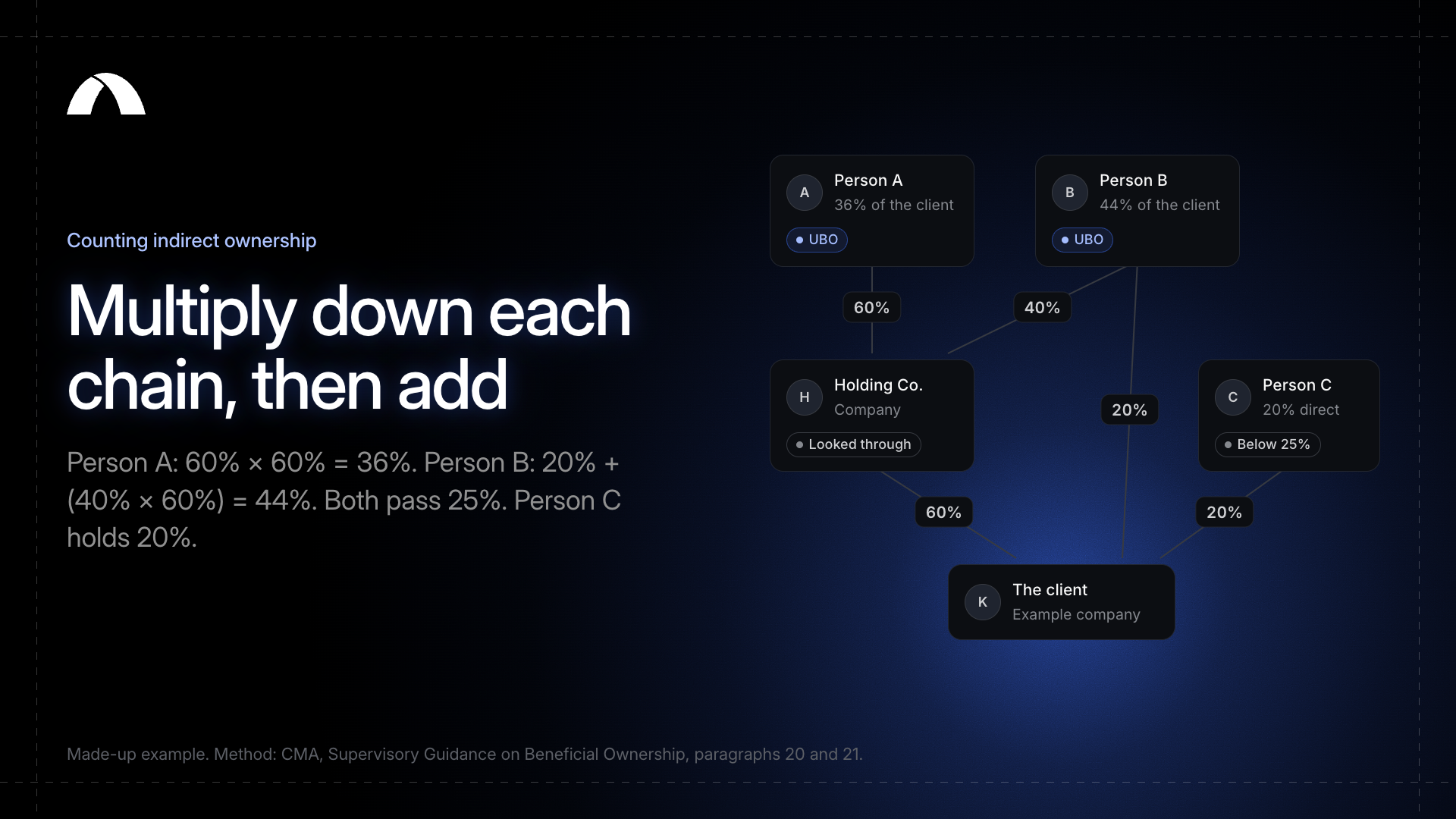
Here is a worked example with made-up names and numbers. It follows the CMA's method.
In the example, Holding Co. owns 60% of the client. Person A owns 60% of Holding Co., so A holds 36% of the client (60% × 60%) and is a beneficial owner. Person B owns 20% of the client directly and 40% of Holding Co., so B's indirect holding is 24% (40% × 60%). Neither part reaches 25% on its own, but together B holds 44% and is a beneficial owner too. Person C owns 20% directly and nothing else, so C does not pass the ownership test. C can still be a beneficial owner through control. Holding Co. itself is never the answer: a company in the chain is looked through to the people behind it.
What the company must do
Article 5 of the rules sets the company's duties [1]:
- At incorporation. The application to set up a company includes its beneficial-owner data [1].
- Companies that already existed. They disclose their beneficial owners by their first annual confirmation date after the rules took effect [1].
- Get and verify the data. Obtain sufficient, accurate and current data, and verify it with risk-based measures and documents from a reliable, independent source [1].
- Keep a register. Keep a beneficial-owner register with supporting documents at the head office in the Kingdom, and record every change [1].
- File changes within 15 days. Send the Ministry any change within 15 days, with the reasons [1]. Filings go through the company's Saudi Business Center account [3].
- Confirm every year. Confirm the data once a year. The due date is one year from the company's registration in the Commercial Register, and the confirmation can be sent up to 30 days early [1].
- Answer financial institutions. Give the data, on request, to the financial institutions and designated non-financial businesses and professions that serve the company [1].
For each beneficial owner, the data includes the full name, nationality, date and place of birth, ID or passport details, address and contact details. It also records which test applies, with the nature and extent of the ownership or control [1]. The Ministry notifies each person declared in its register by phone or email [1].
Failures can lead to penalties under the Companies Law. The rules themselves set no amounts [2].
What a CMA-licensed firm checks
A company's filing does not replace a licensed firm's own due diligence. Before taking on a client or doing any securities business with or for it, a CMA-licensed firm must comply with the Anti-Money Laundering Law and its Implementing Regulation [6][8]. The regulation requires the firm to identify each client's beneficial owners and take reasonable measures to verify them, so that it is satisfied it knows who they are [7]. For a company client, the firm must also understand its ownership and control structure [7].
The 25% threshold reaches CMA firms through the Implementing Regulation of the Anti-Money Laundering Law, which the CMA's guidance quotes [5][7]. It uses the same three steps: ownership of 25% or more, then control by other means, then the senior managing official [7].
In practice, the firm:
- Asks for the register. The rules oblige the company to give its beneficial-owner data to a financial institution on request [1].
- Checks it against independent documents. The CMA's Investment Accounts Instructions give a guidance list of documents for a Saudi company's account, including the commercial register, the articles of association and a list of the directors and senior managers [8]. The CMA's beneficial ownership guidance asks for more sources as the structure gets more complex, such as shareholder and nominee agreements [5].
- Recalculates indirect holdings. It multiplies down each chain and adds each person's holdings [5].
- Checks who acts for the client. It checks that anyone acting for the client, such as an authorised signatory, has the authority to do so, and identifies and verifies that person [7][8].
- Verifies on time. It verifies the client and the beneficial owners before or during the start of the relationship. If it cannot complete due diligence, it does not open the account, or it ends an existing relationship, and it considers a suspicious transaction report [7].
- Keeps the data current. It reviews its records to keep them current, especially for higher-risk clients [5][7]. It asks clients to update their information on any change, on expiry or at the end of a period the firm sets by risk, whichever comes first, and it reviews the need to update at least once every five years [6][8]. It keeps due diligence records for at least ten years after the relationship ends [7].
How AIN covers each point
AIN is Dal's compliance platform. As described on getdal.sa, it maps to each point like this:
- The company record. Enter a Unified Number (700), and AIN fetches the business record from Wathq, Saudi Arabia's local registry, and verifies it in real time. Every Saudi legal entity type is covered.
- The tests. AIN detects UBOs by 25% ownership and by effective control. A person who controls the company without 25% ownership is still detected.
- Indirect ownership. The ownership structure unfolds through nested entities automatically, and effective ownership is calculated for each node.
- Screening. Every detected UBO is screened like any client, against 2,700+ watchlists, Nafith, Makken and adverse media. Their risk folds into the client's score.
- Keeping it current. KYB expiry management sends renewal alerts before records go stale.
Some duties stay with your people in any system: judging control when no one reaches 25%, checking documents against the register, and deciding when a gap needs a report.
To see how AIN traces a client's ownership, Book a Demo at getdal.sa.
Frequently asked questions
What are the Saudi Beneficial Owner Rules?
They are the Ministry of Commerce's rules on who owns and controls a company, issued by Minister of Commerce Decision No. (99) of 26 November 2025 under Article 274 of the Companies Law. They took effect on 4 January 2026 and replaced the first rules of 2025 [1][3].
What percentage makes someone a beneficial owner in Saudi Arabia?
25% or more of the company's capital, held directly or indirectly. If no one reaches 25%, or there is doubt, the test is effective control. The last resort is the director, a board member or the chairman [1].
Can a company be a beneficial owner?
No. The rules define a beneficial owner as a natural person [1]. A company in the ownership chain is looked through to the people behind it.
How is indirect ownership calculated?
The rules do not set a method, and the Ministry is to publish a guiding manual [1]. The CMA's guidance for licensed firms multiplies the percentages down each chain and adds each person's holdings [5].
How soon must a change be reported?
Within 15 days of the change, with the reasons [1]. Filings go through the company's Saudi Business Center account [3].
Which companies are exempt?
Joint stock companies listed on the market are outside the rules. A subsidiary of a listed company that is subject to beneficial-owner disclosure does not disclose its beneficial owners, but it gives the Ministry evidence of the exemption [1].
What are the penalties?
The rules refer to penalties under the Companies Law and set no amounts [2]. A draft that would set a fixed SAR 500 penalty for failing to disclose or confirm has not been enacted [3]. For the first rules, the Ministry said penalties could reach SAR 500,000 [4].
Does a CMA-licensed firm still need its own checks?
Yes. A CMA-licensed firm must comply with the Anti-Money Laundering Law and its Implementing Regulation, which require it to identify every client's beneficial owners and verify them before or during the start of the relationship [6][7]. The company's register is a source to check, not a substitute for the firm's own due diligence.
Sources
- Ministry of Commerce, Rules of the Beneficial Owner, issued by Minister of Commerce Decision No. (99) dated 05/06/1447 AH (26 November 2025), published in Umm Al-Qura issue 5127 on 5 December 2025: preamble and Articles 1 to 9. English text on Qanoniah. https://qanoniah.com/en/File/EDqA4JMjko8AAXzLaV0p3X9gN-Rules-of-the-Beneficial-Owner (accessed 2026-10-18).
- Clyde & Co, "Saudi Arabia's new Beneficial Owner Rules: Key regulatory developments and compliance considerations", 20 January 2026, including its summary of Articles 10 to 12. https://www.clydeco.com/en/insights/2026/01/saudi-arabia-s-new-beneficial-owner-rules (accessed 2026-10-18).
- BCLP, "Saudi Arabia: New Ultimate Beneficial Owner (UBO) Rules Issued", 18 December 2025. BCLP gives the decision number as 267; the rules' own text reads 99. https://www.bclplaw.com/en-US/events-insights-news/saudi-arabia-new-ultimate-beneficial-owner-ubo-rules-issued.html (accessed 2026-10-18).
- Arab News, "Saudi Arabia tightens corporate ownership rules to boost transparency", 24 February 2025, reporting the Ministry of Commerce on the first rules. https://www.arabnews.com/business/saudi-arabia-tightens-corporate-ownership-rules-to-boost-transparency-2591456 (accessed 2026-10-18).
- Capital Market Authority, Supervisory Guidance on Beneficial Ownership: paragraphs 14, 20 to 29 and 36, including Example 4. https://cma.gov.sa/en/RulesRegulations/Circulars/Documents/Beneficial_Ownership_Guideline_en.pdf (accessed 2026-10-18).
- Capital Market Authority, Capital Market Institutions Regulations, as amended by Resolution 2-3-2026 dated 7 January 2026: Articles 37 and 39(c). https://cma.gov.sa/en/RulesRegulations/Regulations/Documents/the_Capital_Market_Institutions_Regulations-en.pdf (accessed 2026-10-20).
- Anti-Money Laundering Law, issued by Royal Decree M/20 dated 05/02/1439H, and its Implementing Regulation, English text on the SAMA rulebook: Law Articles 1(15) and 12; Regulation 7/2, 7/3, 7/6 and 7/8. Amendments in April 2026 changed other articles, not these. https://rulebook.sama.gov.sa/en/implementing-regulation-anti-money-laundering-law-0 (accessed 2026-10-20).
- Capital Market Authority, Investment Accounts Instructions, as amended by Resolution 1-2-2026 dated 5 January 2026: Articles 3(a), 3(d), 7(a)(3) and 14(a), and Annex 1. https://cma.gov.sa/en/RulesRegulations/Regulations/Documents/Investment_Accounts_Instructions_en.pdf (accessed 2026-10-20).